
Generative AI Course

4.7 Rating

800

Master the Genereative AI which includes Python,Data Preparation, NLP, Deep Learning, Chat GPT, Prompt Engineering etc and and elevate your career to the next level.

Why should you go for Generative AI Course?

About Generative AI Course Online Training

The Generative AI Training in Hyderabad at Etekkis Academy is designed to provide a comprehensive learning experience in cutting-edge AI technologies. The course covers fundamental and advanced concepts of generative models, suc1h as:

  • GANs (Generative Adversarial Networks) – Used for creating realistic images and videos.
  • VAEs (Variational Autoencoders) – Essential for data compression and image generation.
  • Transformers – The backbone of models like GPT-4 and BERT, used for text synthesis and natural language processing.

Through hands-on projects, learners will design, train, and deploy AI models for a wide range of real-world applications such as image generation, text synthesis, and AI-driven creativity. The course also involves practical exposure to Python, TensorFlow, and PyTorch to ensure learners acquire industry-relevant expertise. Through expert mentorship and a practical, project-based approach, this course equips you with a successful career in generative AI.

Generative AI Upcoming Batches & Fees

Curriculum

Basics of Python Programming
Installation and Setup:
Installing Python and setting up a development environment (IDEs
like PyCharm, VSCode, Jupyter Notebooks)

Syntax and Basic Constructs:

  • Variables and data types (integers, floats, strings, booleans)
  • Basic input and output
  • Comments and documentation
  • Control Structures

Conditional Statements:
 if, elif, else
 Loops:

  • for, while
  • Loop control statements (break, continue, pass)

Functions
Defining Functions:

  • Parameters and return values

Scope and Lifetime:

  • Local and global variables

Lambda Functions:

  • Anonymous functions
  • Introduction to Generative AI
  • AI vs ML vs DL vs NLP vs Generative AI
  • Generative AI principles
  • What is the role of ML in Gen-AI
  • Different ML techniques (Supervised, Unsupervised, Semisupervised & Reinforcement Learning)
  • Applications in various domains
  • Ethical considerations
  • NLP essentials
    ● Basic NLP tasks
    ● Different text classification approaches
    ● Frequency based – Bag of words,TF-IDF, N-gram.
    ● Distribution Models – CBOW, Skipgram(Traditional approaches)and
    word2vec, Glove.
    ● Ensemble Methods (Random Forest, Gradient Boosting, AdaBoost) &
    Traditional Machine Learning Models – Naïve Bayes, Support Vector
    Machine (SVM), Decision Trees, Logistic Regression.
    ● Deep learning techniques – CNNs, RNNs, LSTMs, GRU and
    Transformers.
  • Autoencodes
    ● VAE’s and applications
    ● GAN’s and it’s applications
    ● Different types of GAN’s and applications
  • Different types of Language models
    ● Applications of Language models
    ● Transformers and its architecture
    ● BERT, RoBERTa, GPT variations
    ● Applications of transformer models
  • What is Prompt Engineering
    ● What are the different principles of Prompt Engineering
    ● Types of Different Prompt Engineering Techniques
    ● How to Craft effective prompts to the LLMs
    ● Priming Prompt
    ● Prompt Decomposition
  • Generative AI lifecycle
    ● What is RLHF
    ● LLM pre-training and scaling
    ● Different Fine-Tuning techniques
  • What are word embeddings
    ● What is the use of word embeddings, where we can use it?
    ● Word Embeddings – Word2Vec, GloVe and FastText
    ● Contextual Embeddings – ELMo , BERT and GPT
    ● Sentence Embeddings – Doc2Vec, Infersent, Universal Sentence
    Encoder
    ● Subword Embeddings – BPE(Byte Pair Encoding), Sentence Piece
    ● Usecase of Embeddings.
  • What is Chunking
    ● What is the use of chunking the document
    ● What are the traditional effective chunking techniques
    ● What are the problems and limitations with traditional chunking
    techniques?
    ● How to overcome the limitations of Traditional chunking
    ● Advanced Chunking Techniques:
    1. Character Splitting
    2. Recursive Character Splitting
    3. Document based Chunking
    4. Semantic Chunking
    5. Agentic Chunking
  • What is RAG
    ● What are the main components of RAG
    ● High level architecture of RAG
    ● How to Build RAG using external data sources
    ● Advanced RAG
  • What is Langchain
    ● What are the core concepts of Langchain
    ● Components of Langchain
    ● How to use Langchain agents
  • LlamaIndex
    ● What are Vector Databases
    ● Why do we prefer Vector Databases over Traditional Databases
    ● Different Types of Vector Databases: OpenSource and Close Source
    ● OpenSource: Chroma DB, Weaviate,Faiss,Qdrant
    ● Close-Source Vector Databases:Pinecone,ArangoDB,Cloud-Based
    Solutions
  • Supervised Finetuning
    ● Repurposing-Feature Extraction
    ● Advanced techniques in Supervised Finetuning -PEFT -LoRA, QLoRA
  • Text based LLMs
    Automatic Evaluation: BULE Score, ROUGE Score, METEOR, BERT
    Score.
    Human Evaluation: Coherence, Factuality, Originality, Engagement

    Image based LLMs
    Automatic Evaluation: Pixel-level metrics, FID (Frechet Inception
    Distance), IS (Inception Score), Perceptual Quality Metrics,
    Diversity Metrics.
    Human Evaluation: Photorealism, Style, Creativity, Cohesiveness

    Audio generation LLMs
    Automatic Evaluation:  

    FAD (Frechet Audio Distance), 

    IS (Inception Score), 

    Perceptual Quality Metrics – PAQM, 

     PAQM – SNR (Signal-to-Noise Ratio), 

    PAQM – PESQ (Perceptual Evaluation of Speech Quality)
    Human Evaluation

    Perceptual Quality – PQ, 

     PQ- Naturalness,

     PQ-Fidelity, 

    PQ- Musicality, 

    Task Specific Evaluation.

    Video Generation LLMs
    Automatic Evaluation: FVD (Frechet Video Distance), Inception
    Score(IS), Perceptual Quality Metrics, Motion Based Metrics –
    Optical Flow Error, Content-Specific Metrics.
    Human Evaluation: Visual Quality, Temporal Coherence, Content
    Fidelit.

  • Model Deployment and Management

  •  Scalability and Performance Optimization

  •  Security and Privacy

  •  Monitoring and Logging

  • Cost Optimization

  • Model Interpretability and Explainability.

  • Amazon Bedrock, Azure OpenAI
  • ChatGPT, Gemini, Copilot

    Request for more information

    Why Generative AI Course Training with Etekkis?

    World-Class Tutors

    • Learn from the best, experience-wise AI and machine learning
    • Mentored by industry-leading professionals providing practical insights in the real world
    • Get doubts solved in real-time to facilitate smooth learning.
    Practical project-based learning

    • 32+ hours of training involving practical, real-world AI application scenarios
    • Innovative Quizzes and skills building assignments
    • Practical Exercises to Reinforce Learning
    Lifetime course access

    • Unlimited access to course materials to learn at your own pace.
    • Free updates on future content to keep your knowledge up-to-date.
    • Revisit the course anytime for continued learning and professional growth.
    Industry Recognised Certification

    • Achieve a performance-based achievement certificate to prove your expertise.
    • Obtain a completion certificate with grading details for professional recognition.
    • Earn an AI certification that improves your credibility in the job market.
    Complete Job Support

    • Resume building support and guidance to ace AI job selection.
    • Mock Interviews and preparation work to increase their confidence.
    • Guaranteed and job placement programs to get placements in top organization.
    Industry Relevant Curriculum

    • Updated curriculum on recent trends and issues.
    • Comprehensive syllabus is curated by industry professionals.
    • Unlimited Learning Opportunities Anytime

    Projects

    Developed a Python-based RESTful web application using Flask/Streamlit for a financial institution. The project included implementing OAuth authentication and CRUD operations, providing a seamless user interface for both employees and customers. The system enhanced operational efficiency through secure data management and real-time access.

    Created a sophisticated AI-driven facial detection and swapping system for real-time surveillance, optimized for Nvidia Jetson Orin edge devices. Integrated with CCTV systems, this solution enhances security monitoring with real-time face recognition capabilities.

    Integrate the trained model into a web application or API, and deploy it in a production environment. Test the application’s performance and ensure smooth processing of user inputs and analysis generation. Deliverables include a functional application, deployment, and performance test results.

    Develop a data pipeline to collect and preprocess historical stock market data, converting stock charts into images for CNN analysis. Train and optimize a CNN model by experimenting with architectures and hyperparameters, and evaluate performance on a validation dataset.

    Test the model on real-time stock data, refining its architecture and preprocessing pipeline for better accuracy and generalization. Monitor model performance with real-time data and implement a feedback loop to enhance predictions based on actual market movements.

    Developed a deep learning system using CNNs for detecting teeth and diagnosing dental issues from panoramic X-rays. This automated tool helps dental professionals by improving diagnostic accuracy and speeding up radiography analysis.

    Job Roles After Generative AI Course

    • AI research scientist: responsible for developing and improving AI Models for innovation.
    • Machine Learning Engineer – Designs and deploys AI-powered applications.
    • Data Scientist – Uses AI models to analyze and interpret complex data.
    • AI Consultant – Provides AI-driven solutions to businesses and organizations.
    • NLP Engineer – Specializes in language models for chatbots and virtual assistants.

    The demand for generative AI expertise is surging, making now the perfect time to upskill and seize high-paying job roles.

    Reviews

    etekkis Certification

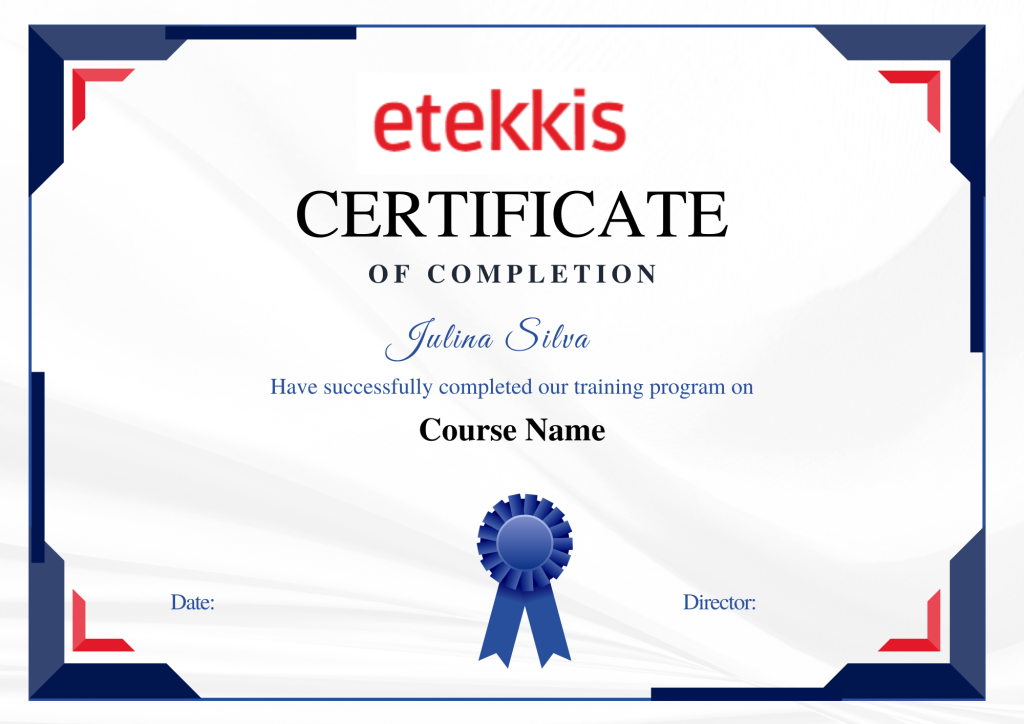
    Etekkis Academy provides Course completion certificate after successful completion of our training and practical based projects.

    Earn an industry-approved certification endorsing your expertise in AI and skills.

    Your certification will consist of a grade breakdown that will enable potential employers to judge your expertise.

    Share your AI credentials on LinkedIn, showcasing your professional profile and improving your marketability.

    Most top companies accept Etekkis certifications, so you are better placed in a competitive job market.

    Generative AI Course

    FAQs

    Absolutely! The course is beginner-friendly, starting with foundational AI concepts. Although basic knowledge of Python is helpful, our structured curriculum ensures a smooth learning journey.

    Generative AI is a sub-area of AI that generates new content—text, images, audio, or video—based on patterns in existing data. Etekkis offers an all-inclusive, hands-on learning experience from basic AI concepts to advanced applications.

    Etekkis offers this course at an affordable price. For the latest pricing and discounts, visit the official website or contact the support team.

    Yes! With lifetime access, you can revisit the course materials anytime for continued learning and career growth.

    Our trainers are industry professionals with years of experience in AI, machine learning, and data science. Many of them have advanced degrees and certifications.

    Absolutely! You will be working on real-world AI projects, including areas such as AI-generated content, chatbot development, and more advanced AI models like GANs and autoencoders.


    Popular Courses

    For Training Requirements:

    Contact etekkis for your training needs

      Quick Enquiry